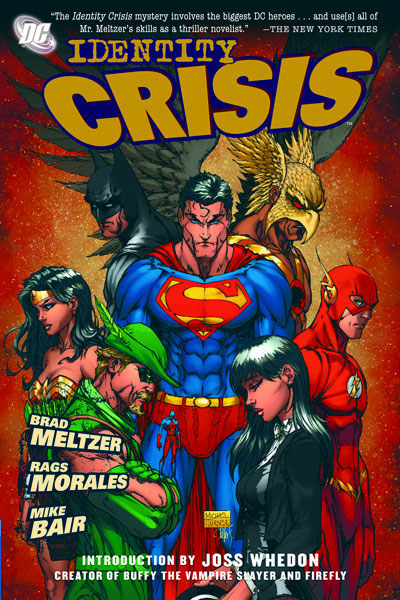
Identity Crisis
Written by Brad Meltzer. Illustrated by Rags Morales and Mike Bair.
Published by DC Comics (2006)
[Note: The issues that made up this series originally came out in 2004, but the paperback edition of the collection didn't make it out until 2006.]
I remember back when this series was coming out there was some controversy as to how it treated the characters. It took characters who had been in the Justice League in the 1970s and 1980s and retconned things so that the old stories seemed a lot darker than they had been. I remember that I didn't really have any relation to those characters, so at first I didn't "get" what some of the criticism was. But I went and read issues of Justice League International (and similar series) out of quarter bins, and I soon grew to enjoy those old series and was kind of saddened by how the characters were treated in this series.
A decade later, I kind of wonder why on earth this series was put on a YALSA top ten list. The only real excuse I can think of, is that 2007 was the first year they created one of these lists, they didn't really know what they were doing, and that it was a big event comic (so of course it's good?), because fuck it is kind of terrible. So terrible it's been put on a list of the worst comics of 2000-2009.
So, what is it, and why is it so bad? It's a mystery where the "whodunit" turns out to be someone completely unrelated to all of the previous hints and clues, and whose personality was radically changed in order to make them the perpetrator. It's a superhero story with murder, rape, misogyny, and other horrible stuff done so as to "humanize" the characters. (Of course, none of that happens to any of the superheroes, instead it all happens to members of their family. To make them FEEL THINGS.) I'm not saying superhero comics can't tell deep, emotional stories that feature those elements, but doing it to Elongated Man (or whoever) seems to cheapen everything else they've done. Superhero comics basically work on suspension of disbelief, and this comic seems to go out of it's way to break characters and make you realize how nonsensical the DC universe is. It has superheroes doing things that they they seem like assholes, and the problem with shared universes is that the characters and stories don't exist in isolation. Someone else is going to use the characters later, and they'll have to deal with this stuff.
You'd think Meltzer might understand that as one of the reasons he wrote this comic was to explain why Dr. Light was a terrible villain in the comics he read as a kid. He had to do this in a "realistic" way, making things grim and gritty, and ignoring the facts that pretty much everyone was a terrible villain back then and that they're superhero comics. It's not always appropriate to make characters do "realistic" things.
Okay, let's talk about Women in Refrigerators. This is a term (created by comic writer Gail Simone) to describe the many, many terrible things that happen to women characters in comics, frequently just so that the main (male) characters can have something bad happen to them without it actually _happening_ to them. The titular case was when a Green Lantern came home to find that his girlfriend had been killed and stuffed inside his fridge.
Identity Crisis does this in spades. Sure bad things happen to some male characters too, but even in death the female characters seem more screwed over. I mean, why be killed by a boomerang when you can be raped, and then killed, and then set on fire?
The last year or so has really seen an increase in comics that feature female leads, which is great, but reading something like this makes me wonder how long it is until Ms. Marvel gets raped or has her arms ripped off or something. A lot of writers, editors, and other people involved in comics seem to think that superheros need to be dark and gritty and...terrible. I wish they'd stop.
There was recently a controversy over an alternative cover for an issue of the Batgirl series currently coming out. Some fans felt (rightly so) that the cover (which heavily suggests sexual assault and can make Batgirl look like a victim) was inappropriate for the type of book that Batgirl is. I agree. Regardless of whether you think the cover is a good piece of art, you can't take it out of context. You have to view it as a cover for a comic, and consider what the contents of that comic are going to be. People (and there seem to be a lot of them) who say "No! It's a great cover! It's creepy and well drawn." are missing the point. It's not whether it's good, it's whether it's appropriate for it's context. A lot of people seem to feel it's appropriate for Batgirl, and I wonder what other comics they'd have been fine with this cover being on. Batman Adventures? Scooby Doo? Tiny Titans?
The reaction of those fans makes me pretty sad. So of course you'll all be happy to know that a tenth anniversary hardcover of Identity Crisis came out in December of last year. I'm sure a lot of fans love it's "realistic" take on superheroes.
[Note: The issues that made up this series originally came out in 2004, but the paperback edition of the collection didn't make it out until 2006.]
I remember back when this series was coming out there was some controversy as to how it treated the characters. It took characters who had been in the Justice League in the 1970s and 1980s and retconned things so that the old stories seemed a lot darker than they had been. I remember that I didn't really have any relation to those characters, so at first I didn't "get" what some of the criticism was. But I went and read issues of Justice League International (and similar series) out of quarter bins, and I soon grew to enjoy those old series and was kind of saddened by how the characters were treated in this series.
A decade later, I kind of wonder why on earth this series was put on a YALSA top ten list. The only real excuse I can think of, is that 2007 was the first year they created one of these lists, they didn't really know what they were doing, and that it was a big event comic (so of course it's good?), because fuck it is kind of terrible. So terrible it's been put on a list of the worst comics of 2000-2009.
So, what is it, and why is it so bad? It's a mystery where the "whodunit" turns out to be someone completely unrelated to all of the previous hints and clues, and whose personality was radically changed in order to make them the perpetrator. It's a superhero story with murder, rape, misogyny, and other horrible stuff done so as to "humanize" the characters. (Of course, none of that happens to any of the superheroes, instead it all happens to members of their family. To make them FEEL THINGS.) I'm not saying superhero comics can't tell deep, emotional stories that feature those elements, but doing it to Elongated Man (or whoever) seems to cheapen everything else they've done. Superhero comics basically work on suspension of disbelief, and this comic seems to go out of it's way to break characters and make you realize how nonsensical the DC universe is. It has superheroes doing things that they they seem like assholes, and the problem with shared universes is that the characters and stories don't exist in isolation. Someone else is going to use the characters later, and they'll have to deal with this stuff.
You'd think Meltzer might understand that as one of the reasons he wrote this comic was to explain why Dr. Light was a terrible villain in the comics he read as a kid. He had to do this in a "realistic" way, making things grim and gritty, and ignoring the facts that pretty much everyone was a terrible villain back then and that they're superhero comics. It's not always appropriate to make characters do "realistic" things.
Okay, let's talk about Women in Refrigerators. This is a term (created by comic writer Gail Simone) to describe the many, many terrible things that happen to women characters in comics, frequently just so that the main (male) characters can have something bad happen to them without it actually _happening_ to them. The titular case was when a Green Lantern came home to find that his girlfriend had been killed and stuffed inside his fridge.
Identity Crisis does this in spades. Sure bad things happen to some male characters too, but even in death the female characters seem more screwed over. I mean, why be killed by a boomerang when you can be raped, and then killed, and then set on fire?
The last year or so has really seen an increase in comics that feature female leads, which is great, but reading something like this makes me wonder how long it is until Ms. Marvel gets raped or has her arms ripped off or something. A lot of writers, editors, and other people involved in comics seem to think that superheros need to be dark and gritty and...terrible. I wish they'd stop.
There was recently a controversy over an alternative cover for an issue of the Batgirl series currently coming out. Some fans felt (rightly so) that the cover (which heavily suggests sexual assault and can make Batgirl look like a victim) was inappropriate for the type of book that Batgirl is. I agree. Regardless of whether you think the cover is a good piece of art, you can't take it out of context. You have to view it as a cover for a comic, and consider what the contents of that comic are going to be. People (and there seem to be a lot of them) who say "No! It's a great cover! It's creepy and well drawn." are missing the point. It's not whether it's good, it's whether it's appropriate for it's context. A lot of people seem to feel it's appropriate for Batgirl, and I wonder what other comics they'd have been fine with this cover being on. Batman Adventures? Scooby Doo? Tiny Titans?
The reaction of those fans makes me pretty sad. So of course you'll all be happy to know that a tenth anniversary hardcover of Identity Crisis came out in December of last year. I'm sure a lot of fans love it's "realistic" take on superheroes.


