Every year since 2007 the Young Adult Library Services Association (YALSA) section of the American Library Association (ALA) has created both a long list and a top ten list of "great graphic novels for teens". You can see all the lists here. Previously they had included some graphic novels on their "best books for young adults" lists.
Last year I was invited to give a guest lecture on the history of comics and graphic novels for children and young adults, and upon looking at these lists realized that I had read less than half of the book on the top ten lists (and hadn't even heard of others!). As a so called "expert" on graphic novels in libraries I didn't really think that this was appropriate, and decided to read as many of the volumes that I hadn't read as possible.
I'll be reviewing them as I read (or reread) them, and this page will eventually contain links to all the books from 2014. Here's the full list of nominations from 2014, and the top ten list. This year I've read fewer of these books than ever (approximately 1.5)! I blame being in grad school.
Will & Whit by Laura Lee Gulledge.
The Adventures of Superhero Girl by Faith Erin Hicks.
Dogs of War by Sheila Keenan and Nathan Fox.
MIND MGMT (Volume 1) by Matt Kindt.
Rust (Volume 2) by Royden Lepp.
March (Volume 1) by John Lewis, Andrew Aydin, and Nate Powell.
War Brothers: The Graphic Novel by Sharon McKay and Daniel Lafrance.
Strobe Edge (Volumes 1-6) by Io Sakisaka.
Nothing Can Possibly Go Wrong by Prudence Shen and Faith Erin Hicks.
Boxers & Saints by Gene Luen Yang.
Sunday, February 16, 2014

Wednesday, January 22, 2014
Tintin in the Land of Potential Censorship
I'm a pretty big Tintin and Hergé fan. I first read the comics as a child, and I even remember going to libraries to borrow the comics. The first one I owned was Prisoner's of the Sun, and I think that its use of in media res (as the second book in a two part story) has influenced my enjoyment of creating stories that start in the middle.

I've read all the Tintin comics (and several of Hergé's other comics), read the novel, own several of the pastiches that have been created, have read or watched comics, books, and documentaries about Tintin and Hergé, watched the various animated shows (and will watch those weird old live action movies at some point), went to Belgium just so that I could go to the Hergé Museum, have owned pieces of the merchandise (including rad standees when I was a kid, and a watch I wore until it broke), had Tintin's haircut for years, and in some ways feel that my life as a globe trotting, occasional journalist that wants to have adventures was influenced by Tintin.
So I say this as someone who really loves the character: Tintin in the Congo is a racist book that should not be in children's sections of libraries (or bookstores for that matter).
Now, I've seen this book in children's sections before (that's where I first read it a few years ago), but I'm writing this post because of this article about a library that refuses to move the book out of the children's section after parents complained.
First a bit of background. Tintin in the Congo was the second Tintin adventure after Tintin in the Land of the Soviets. It was originally published from 1930 to 1931, but this version doesn't really look much like what most people expect Tintin to look like. Hergé was still a fairly young and inexperienced artist at this point in his career so the art isn't as developed as it would later be, plus the books were published in black and white. Later he redrew and colourized his earliest books (excluding Tintin in the Land of the Soviets), and this revamped version was released in 1946. Later revisions (to remove a rhino being blown up) where made in the 1970s at the request of publishers in other countries.
Despite those changes the colour version of this book was not published in English until 2005. (A reproduction of the original black and white version was published in the early 1990s, but that was aimed a collectors.)
Now I could go into all the problems with the book, but there are other articles written by people who have read it more recently than I have (and I'm not that interested in rereading it). So try this one or this one.
I'm not saying Tintin in the Congo shouldn't be in libraries, but putting it in a children's section seems misguided and ignorant at best, and malicious at worst. Honestly, there aren't enough portrayals of people of colour in any comics, let alone in comics aimed at kids, and so having one that is super racist against Africans seems like a terrible, terrible idea.
The head librarian at the library in question apparently said that moving the books was the same as censoring them, which seems kind of strange to me. They quote the ALA definition of censorship as a "change in the access status of material, based on the content of the work and made by a governing authority or its representatives", while saying that “If the Jones Library does nothing else, we protect everyone’s constitutional right to read anything he or she wants. Our mission does not include censorship.”
How does moving this book to the adult graphic novel or 741.5 section change the access status? Children can still find it (and in fact more people overall would see that the book exists). I have to wonder what this library would do if a book was miscatalogued. If Lost Girls by Alan Moore and Melinda Gebbie was in the kid's section at the library (it's a crossover between Peter Pan, the Wizard of Oz, and Alice in Wonderland!) would it just stay there forever?
When it comes down to it I think the only reason that Tintin in the Congo is shelved in the kids section anywhere is because most cataloguers don't know that much about comic books (I see miscatalogued comics all the time), and so they just put it where all the other Tintin comics go. It's kind of funny that I'm complaining about that this time, as usually I'm upset because a series has been split into multiple different sections, but I think this shows that for librarians knowledge of material and context is important.
Tuesday, January 7, 2014
YALSA top ten 2008: After School Nightmare

After School Nightmare (Volumes 1-5)
Written and illustrated by Setona Mizushiro.
Published by Go! Comi (Volume 1, 2006; Volumes 2-5, 2007)
When I read a comic (or a book, or watch a TV show, etc.) and I really have problems with it I tend to go and read reviews to see if other people had similar problems or if they could justify their experience in a way that made sense to me. (I also do this with media I really enjoy, except then I read reviews of people who hated whatever I liked.) However, when the opinion I have is not only not reflected in any other review I can find, but not even mentioned, I guess I feel as though I'm not reading the comic "right". That's really the case with After School Nightmare: I have multiple problems with it, but nobody else even talks about what I think are sorta serious issues. Now, this is a ten volume series, and the first five were all listed (as one item) on the top ten list, but I only read the first book. (The copy I borrowed was also missing a page at the beginning, that was actually kind of important, but I read it online.)
First of all I admit, and this is going to come up multiple times as I read the comics on these YALSA lists, that I am not a teenage girl and, in fact, have never been one. Thus, shojo comics (Japanese comics aimed at teenage girls) are not something I enjoy very often. I haven't read that much, but other than like Sailor Moon and Magic Knight Rayearth (both of which I read back in the '90s), I'm not sure if I've actually enjoyed any shojo comics at all. So why is this? I mean, I've read and enjoyed the Baby-sitters Club graphic novel that Raina Telegemeier did, so I'm clearly not _that_ averse to comics aimed at young females (though there are lots of western ones that I also don't care for), but clearly something about these titles hasn't clicked with me. However, even saying something like that is unfair, as shojo isn't a genre, and the titles published under that title can be anything from sports to science fiction. But of the ones I've read, the overly dramatic characters and focus on absurd "romances" have left me cold.
After School Nightmare is set in a bizarre school where students have to attend a "class" where they are put to sleep and must reveal their true selves/darkest secrets to other students. In order to graduate they have to find a "key" which is hidden inside the body of another student. This is kind of weird, though I'd be more okay with it if there wasn't so much non-consent involved. The mysterious "nurse" who tells the main character that they have to do this doesn't tell them what it is they have to do or what's going to happen beforehand (or even afterwards!), instead they just drug them with some weird type of tea, and another student eventually explains what this "class" is about. After the main character has unwillingly entered a dream world where students get to repeatedly relive horrible experiences like sexual and physical assault.
But that's not even my real problem with this comic, and we'll get to that in a second after I give a brief plot overview. The main character Ichijo Mashiro's "upper half is male" and their "lower half is female", and a major element of the plot is them trying to come to terms with their own gender identity. This is fine, good even! Teenagers frequently struggle with elements of sexual orientation and gender identity (amongst other aspects of their personal identities), and providing media about that probably helps them understand that they're not alone in how they feel.
However, my problem with this comic is the way the nurse, who is basically the only adult/person in a position of power/supposed role model in the entire comic, acts. Upon meeting Ichijo this character says "I know everything about you. After all, I am your teacher". When Ichijo says "I'm a guy" the nurse says "No, you're merely wear a man's clothing and hope to be believed". Similarly, other characters repeatedly say that Ichijo's "true self" is female, because that's how they show up in the dreams (whereas other students appear as a suit of armour, a person with huge holes were their face and chests are, a disembodied arm, and so forth). It just seems super transphobic to me to have almost everyone refuse to accept this character as the gender they identify as, but nobody else discussing the comic seems to have ever mentioned this, so maybe I'm just reading it wrong.
Thankfully, it isn't all like that. One of the characters (a love interest) actually says "I prefer you being a boy". There's a reasonable story to be told in characters trying to figure out if they're gay or not when they don't identify with their physical gender, and it seems as though later volumes of the series discuss that more. But those aspects didn't really click with me until I read reviews of the series, and then reread this volume (and geeze guys, I just reread a comic I disliked in order to properly say why I disliked it.).
Ignoring any positive or negative thoughts regarding the plot of the book, I found the romance aspects of this incredibly boring. Like there are pages of dialogue that I cannot believe I read as they are just so banal. This is clearly my personal opinion and I'm not saying that _this_ part of the comic is bad, just that it's not something that I generally enjoy, and based solely on that (but also for other reasons) I won't be seeking out any more of this title.
Sunday, January 5, 2014
What do you get when you cross a shy librarian with a demon warrior?

Recently while looking through a 1994 issue of Previews (yes, I am that lame) I came across this ad and solicitation for the first issue of this (terrible looking) comic by Sean Shaw.

Here's the solicitation text:
"What do you get when [you] cross a shy librarian with a demon warrior? Find out in these adventures of a mild-mannered woman caught in the wrong place at the wrong time."
Comics.org has a plot description of the first issue:
"When Rachel tries to help a woman in trouble, she accidentally interferes with a cult summoning a demon and the demon enters her body by mistake."
But more importantly they have cover scans of issues 1, 3, and 4, and Comicbookdb.com has a scan of issue 2.


And believe it or not, but Shaw actually had a career for a fair few years, got to work on an Alan Moore comic (in however minor a capacity), was still drawing covers within the last five-six years, and even attended a con in 2010 with a bio that still promoted his connection to Wicked.
You can even get the first three issues on ebay, and I'd be lying if I said I wasn't tempted. If you want to get them for me I'd be happy to read (and review!) them for your enjoyment, cause I'm guessing I won't get much out of reading them : )
Friday, January 3, 2014
Readers' Advisory for Graphic Novels for Adults
Here's the Readers' Advisory presentation I did about graphic novels for adults at RA in a Half Day. I haven't watched this video. Terrified of seeing myself speak.
Here's the resources handout I created, and the Powerpoint presentation.
Tuesday, December 31, 2013
YALSA 2013 Top Ten Great Graphic Novels for Teens
Every year since 2007 Young Adult Library Services Association (YALSA) section of the American Library Association (ALA) has created both a long list and a top ten list of "great graphic novels for teens". You can see all the lists here. Previously they had included some graphic novels on their "best books for young adults" lists.
I was recently invited to give a guest lecture on the history of comics and graphic novels for children and young adults, and upon looking at these lists realized that I had read less than half of the book on the top ten lists (and hadn't even heard of others!). As a so called "expert" on graphic novels in libraries I didn't really think that this was appropriate, and decided to read as many of the volumes that I hadn't read as possible.
I'll be reviewing them as I read (or reread) them, and this page will eventually contain links to all the books from 2013. Here's the full list of nominations from 2013, and the top ten list. They occasionally have weird formatting or credits.
My Friend Dahmer by Derf Backderf.
Trinity: A Graphic History of the First Atomic Bomb by Jonathan Fetter-Vorm.
Annie Sullivan and the Trials of Helen Keller by Joseph Lambert.
Ultimate Comics Spider-Man (Volume 1) by Brian Michael Bendis and Sara Pichelli.
Friends with Boys by Faith Erin Hicks.
A Flight of Angels by Rebecca Guay, and others.
The Silence of Our Friends by Mark Long, Jim Demonakos, and Nate Powell.
Stargazing Dog by Takashi Murakami.
Drama by Raina Telgemeier.
Daredevil (Volume 1) by Mark Waid, Paolo Manuel Rivera, and Marcos Martin.
Monday, December 30, 2013
YALSA top ten 2012: Scarlet
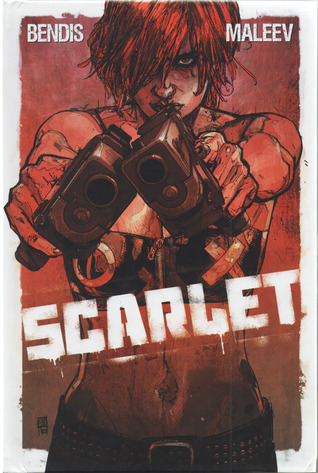
Scarlet
Written by Brian Michael Bendis. Illustrated by Alex Maleev.
Published by Icon/Marvel (2011)
Brian Michael Bendis is probably one of the biggest creators in the "mainstream" (ie. superhero) comic book industry. He's been one of the most successful writers at Marvel for over a decade, writing major books like Avengers and X-Men and leading overarching storylines and events. His "David Mamet-like" dialogue has influenced pretty much all of superhero comics, and for the most part I really don't care for his work.
Actually, that's not really fair. Bendis is nothing if not prolific. He's written hundreds of comics, and when he first started in the industry he was also drawing his own stuff. I enjoyed his early crime books like Jinx and Torso, I didn't get really into Powers, his cops in a superhero world comic, but I'd probably read more of it if you gave it to me, I remember really enjoying Fortune and Glory, his comic about his experiences in Hollywood, and I've read a bunch of his (massive) run on Ultimate Spider-Man (and will read more at some point).
But at the same time, I've hated (or at least not cared for) a lot of his comics. I'm not the biggest Avengers fan, but I pretty much avoided that entire corner of the Marvel Universe for the entire time that Bendis was writing those titles. (When I did read some I found them boring and blah.) He recently became the main writer of the various X-Men related titles, and I was kind of disappointed, as I'd actually been getting back into those books and was reading and enjoying both Kieron Gillen and Jason Aaron's books.
So all of this is to say that I generally don't go out of my way to read Bendis' comics, and if this book hadn't appeared on this list I'd never have bothered seeking it out.
Scarlet is the story is of an early 20s girl who lives in Portland and has her boyfriend killed by a corrupt cop. He gets away with it, and so she vows that she'll get revenge. Does she try to expose corrupt cops? Perhaps try to get them fired or whatever? No, she just kills them. And everyone loves her!
There are definitely some parallels between what the characters in this comic say and what happened with the Occupy protests (ie. having to take stuff into their own hands, because the existing system is broken/corrupt and set up to perpetuate itself), and it's kind of surprising that this series predated all of those events. But I think that's what really frustrated me about this book: it's about dealing with problems that exist in the real world, and instead of the character realistically trying to make a difference they just kill people. Killing people isn't the answer!
I mean, I agree with much of what the characters in this book (and the people involved with the Occupy movement) are saying: a lot of police officers are corrupt assholes (I still feel a little sick whenever I hear about cases like this), the government is horrible, corporations have far too much power, etc. But you know what? I really don't think that in our society killing people is the answer. Especially in the ridiculous vigilante style that is demonstrated in this comic. Scarlet kills these cops, and says that they're corrupt, but never seems to present any evidence about this. Yet people love her anyway. I mean, I know it's set in Portland, but even then...
So yeah, I feel as though this comic takes a real, important event, and reduces it to something that should be ignored. That by making it into a ridiculous revenge fantasy it takes away from the legitimacy of real events that have happened. Yeah, I guess the Occupy movements have proved that nothing will change yet, but I still don't want to start putting people up against the wall when the revolution comes.
As for the art, Maleev's style is not going to be to everyone's liking. His artwork is distinct and recognizable: it's heavily photo referenced, but also grimy and dark. Personally, I like the art quite a bit, though I have two major complaints. The first is that reading the script at the back of the book revealed a few instances of things that I did not think were conveyed particularly clearly through the artwork. Looking at the art after reading the script I could say "oh sure, that's what's happening I guess", but I feel that a fair number of people might miss what was happening their first time through.
The other thing is something I've found in several Bendis comics (though it's possible they're comics Bendis did _with_ Maleev, so it could be either of their faults): pages that don't read like you would expect them to. This isn't even a case of weird panel layout, instead you get (for example) two side by side pages each with six equally sized panels on them. The panels are entirely contained within their own pages, so it's not immediately obvious that you have to read the entire top row of panels and then the bottom row. That's now how comic pages are supposed to work!
Also, the script mentions that a bunch of people in the comic should look like "punks", since nobody actually looks like that either this was an early version of the script that they moved away from, Bendis is referring to all young people as punks (ie. Bendis is old), or Maleev has never seen an actual punk in his life. Also also, the cover sexualizes Scarlet in a kind of creepy way that isn't actually in the comics themselves. I'm not sure if that's good or bad or somewhere in between.
Even ignoring all of that (the good and the bad), it becomes incredibly hard to recommend the first volume of a series when there is no conclusion, and the end doesn't seem to be coming any time soon. In the two and a half years since this book was published a grand total of two more issues have come out. It's not as though Bendis doesn't write many comics, he regularly has five or six out in a single month, and he's still a big star with Marvel so it's not like he couldn't do this series if he wanted to. Maybe that's the thing though, perhaps he knows that Marvel won't always be willing to give him this much work so he should just go with it for as long as possible. I mean, he's got his whole life ahead of him to write stuff like this, so why not spend a few years/decades earning six figures writing X-Men comics? (Of course I'm sure it didn't help that Bendis and Maleev did 12 issues of Moon Knight from 2011-2012.)
Subscribe to:
Posts (Atom)